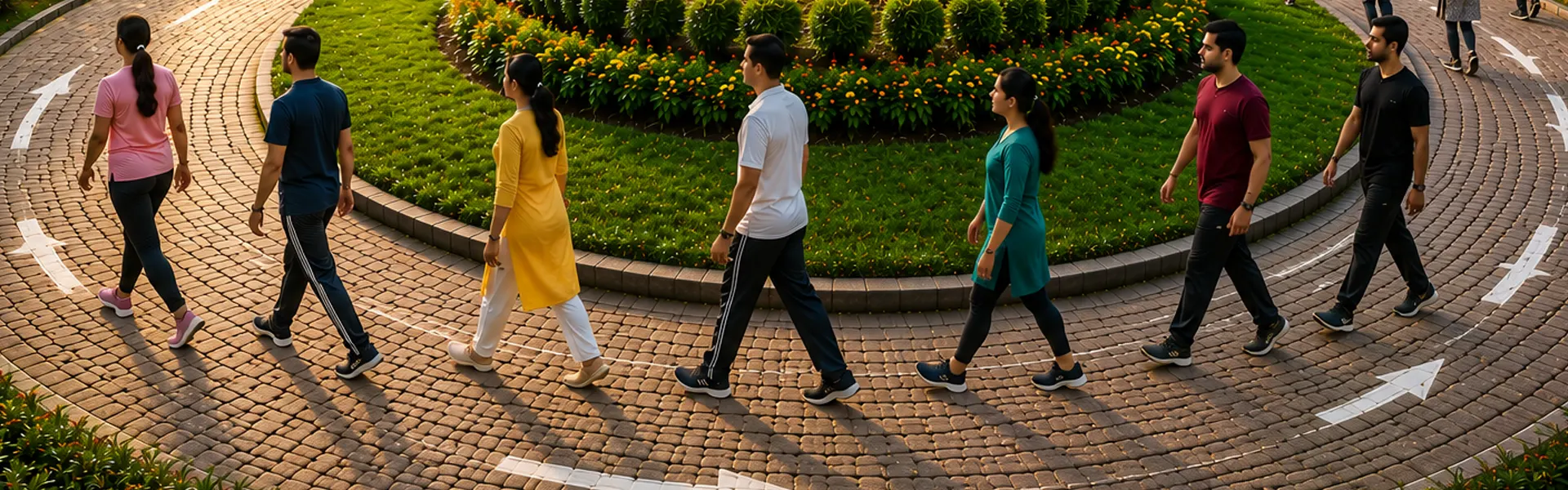

Every morning in the park, I swim against the current. And it turns out, there’s a very good reason why.
Every morning, I arrive at the park, step onto the walking track, and turn left. Without fail, someone shoots me a look — the kind reserved for people who eat pizza with a fork, or press the elevator button that’s already lit. The unspoken rule is clear: you go clockwise here.
I’ve gotten the comments. “Arre bhai, ulti taraf chal rahe ho.” The gentle redirects. The occasional concerned uncle who stops to inform me I’m doing it wrong. And every time, I smile, nod, and keep walking left.
“If going anticlockwise is wrong, someone forgot to tell every athlete who ever ran a competitive race.”
The track was built for you — and it goes left
Here’s the thing nobody in the park seems to know: every athletics track in the world — from your local stadium to the Olympics — mandates anticlockwise running. It’s not arbitrary. It’s physics, anatomy, and centuries of sport science combined.
Heart position
The heart sits slightly left of center. Anticlockwise movement leans into the natural centrifugal pull, easing cardiac load on turns.
Left-leg dominance
Most people push harder off the right foot, making the left leg the natural pivot. Anticlockwise turns use this asymmetry efficiently.
Brain lateralization
Research suggests the right hemisphere — which controls the left side of the body — is dominant in spatial navigation, favoring left turns.
Tracks
Tracks are also built anticlockwise in every stadium.
The park crowd isn’t wrong — they’re just uninformed
I don’t blame the clockwise walkers. Nobody handed us a manual at the park gate. The default in everyday life actually nudges us clockwise — we read left-to-right, doors hinge a certain way, shopping malls are designed to pull you right. The clockwise instinct is understandable.
But “everyone is doing it” has never been a great reason to do anything — especially when “everyone” includes no trained athlete, no physiotherapist, and no track-and-field coach anywhere on earth.
What anticlockwise actually feels like
After a few weeks of deliberately walking anticlockwise, I noticed something: my left knee — which used to ache on longer walks — stopped complaining. My stride felt more balanced. Whether that’s the biomechanics or just placebo, I genuinely don’t care. The walk feels better. I’ll take the data where I find it.
And honestly? There’s something quietly satisfying about being the only person going the other way. You face the crowd. You make eye contact. You feel, in a small way, like you’re not just following the herd — you’re actually thinking about what you’re doing.
“Walk anticlockwise. Not because it’s rebellious. Because it’s right.”
The bottom line
Every Olympic track, every athletics event, every sprint coach in the world sends their athletes anticlockwise. If you’re walking clockwise at your morning park and someone’s doing it the “wrong” way — look a little closer. They might just know something you don’t.


