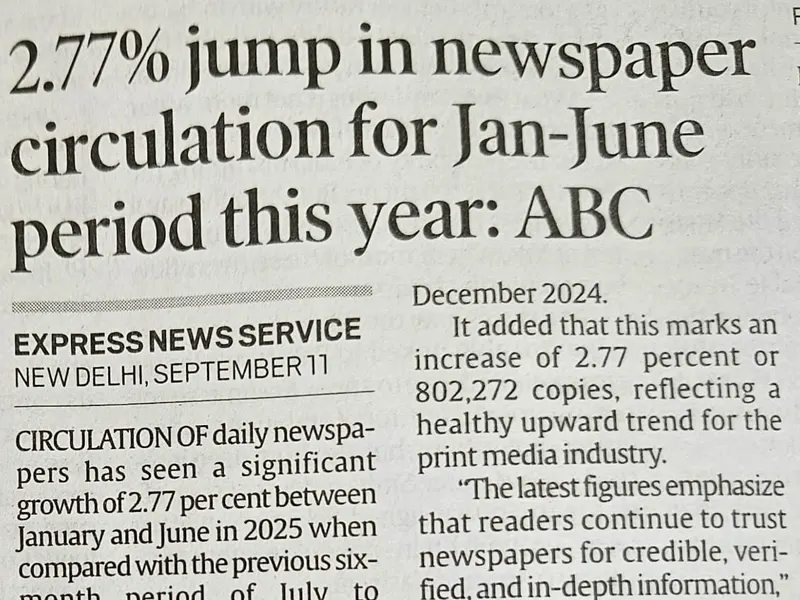
In a year when our feeds seem engineered for agitation, I came across a single line that felt like a hand on the shoulder: “Circulation of daily newspapers has seen a significant growth of 2.77 percent between January and June 2025 when compared with the previous six-month period of July to December 2024 in India, the latest Audit Bureau of Circulation figures show.” On the surface, it sounded implausible. Who, in an era of reels and swipes, is choosing newsprint? Yet the paper reporting it was credible, and the number lodged itself in my mind. I realized that even if the trend was modest, it was an indication of a shift—quiet, almost shy—in how people are choosing to think. For a long time I had believed we had lost this battle for attention; suddenly, change seemed more than a daydream.
I have skin in this game. I was in the sixth class when our teacher, with that calm insistence good teachers have, told us to read the editorial page every day. Not the cartoons or the headlines, but the page where arguments take shape, where ideas must walk on their own legs. I was lost at first. The sentences were long, the vocabulary prickly. I bought a dictionary and kept it on my desk like a second textbook. What began as a struggle became a ritual; what began as a ritual became a habit; and after thirty years, that habit feels like part of my identity. I read the editorial page the way some people lace up running shoes every morning. It’s not entertainment. It’s maintenance.
Meanwhile, the world shifted around me. Friends and colleagues told me they “keep up” via shorts—those atomized videos and posts that compress the world into thirty seconds. They rely on the confidence of the scroll and the adrenaline of the next clip. I’ve tried to persuade them to start with one editorial a day, even a week. Their reluctance is real and, I admit, sometimes irritating. But I understand it. Shorts are frictionless; editorials ask for attention, patience, and a willingness to be challenged. One is snacking; the other is a meal. You can live on snacks for a while. You cannot thrive.
That is why the 2.77 percent figure matters. It’s not just a bump in circulation. It hints at a revaluation of depth in a culture besotted with speed. Numbers alone won’t save us from misinformation, nor will paper defeat pixels. But the figure suggests that a slice of the public is voting with time and money for something slower and sturdier. In a healthy information diet, speed and depth can coexist. The problem arises when speed crowds out everything else—when our thinking gets trained to lunge, not linger.
Newspapers, especially their editorial pages, train the opposite habit. A good editorial is not simply an opinion; it is an argument with scaffolding. You can see how claims relate to evidence, where assumptions sit, which counterarguments have been weighed and which have been dodged. Letters to the editor present adversarial feedback within a civil structure. Columns build a record of thought over months and years. None of this guarantees truth, but it demands accountability. You can cut and paste a sentence from a short; you can’t cut and paste an argument.
My life has been marked by the slow accretion of this kind of reading. When I think back to that sixth-class directive, I can still feel the early embarrassment of keeping a dictionary at hand. Yet that very friction—looking up a word, rereading a paragraph—was the exercise. Over time, the editorial page became a gym for thought: verbal stamina improved, attention stretched farther, nerves hardened against the jolts of outrage that social media trades in. Even now, when I encounter a policy proposal or a controversy, I’m less interested in the hottest take than in the soundness of the reasoning behind it. That disposition was built, article by article, on newsprint.
There are practical reasons to prefer this slow mode, too. Social platforms optimize for engagement, a proxy for revenue, not for accuracy or proportion. Algorithms nudge us toward stimuli that keep us scrolling. Even when we know this, we’re not immune to it. Newspapers—imperfect as they are—operate under a different set of incentives: editorial standards, correction policies, and a tradition of public accountability. When they fail, they are pressed to say so. That tradition is not quaint; it is infrastructure. We recognize the value of physical roads; we are slower to recognize the value of intellectual roads—routes that carry ideas steadily rather than in viral bursts.
This is not a call to smash your phone or to pretend that digital formats cannot support depth. They can, and many do. It is, instead, a plea to recover the habit of deliberateness. If the Audit Bureau of Circulation’s figure signals anything, it is that a portion of readers is self-selecting out of the outrage treadmill and returning to a cadence where thoughts can breathe. Perhaps they are tired of the performative certainty of the timeline. Perhaps they have realized that being informed is not the same as being inundated. Perhaps a teacher once told them, as mine did, to read the editorial page, and the advice lay dormant until adulthood.
What would it look like to make this shift practical? Start small. Choose one reliable newspaper. If print is a hurdle, choose the e-paper; the point is not the smell of ink but the structure of attention. Read the editorial page three days a week for a month. Keep a notebook or a note-taking app open. Jot down one sentence that challenged you, one claim you want to check, one new word you learned. Don’t aim for agreement; aim for understanding. Share one column with a friend and ask, “What did you think of the second argument here?” You will be surprised at how quickly the conversation changes when the stimulus is longer than twenty-five seconds.
For those who say they have no time, consider that time is not found; it is made. The average person can trade three shorts for one column. The difference isn’t just in duration; it’s in mental residue. Shorts tend to evaporate; a good editorial lingers, raising questions you take into your day. The more you do this, the more your attention becomes a muscle rather than a nerve. Muscles grow with resistance. Nerves only fray.
If you are persuading reluctant readers in your circle, resist the temptation to preach. Instead, invite. Send a column that you disagree with and ask them to tell you where the argument is strongest. People are more likely to engage when they are not being told what to think but invited to test how they think.
There is also a civic dimension to this. Democracies are noisy by design; they require the clash of ideas and the slow forging of compromises. But noise is not the same as deliberation. When public life is dominated by snippets designed for virality, our capacity to deliberate shrinks. We become allergic to nuance and addicted to confirmation. Editorial pages, at their best, are rehearsal rooms for civic speech: places to test arguments, learn the rhythm of rebuttal, and practice the humility of changing one’s mind in print. A society that reads editorials is not guaranteed to be wise, but it stands a better chance than one that only watches shorts.
None of this means idolizing newspapers. They err. They carry biases. They sometimes mistake the establishment’s comfort for the public’s good. The point is not to treat them as sacred, but to treat them as serious. Seriousness is itself a scarce resource today. Not all newspapers are serious. It’s the willingness to hold focus long enough for complexity to show itself. The 2.77 percent increase is a small, measurable sign that seriousness still has customers.
I keep thinking about change—how often it hides in plain sight. We expect change to announce itself in neon, but usually it approaches like dawn: dim, consistent, undeniable once you notice the light on the wall. That line in the paper felt like dawn to me. After years of believing that we had lost our collective appetite for patient thought, I saw a glimmer of appetite returning. Maybe it’s just a blip. Maybe it’s the start of a correction. Either way, it is an invitation.
So here is mine. Choose one editorial tomorrow. Keep a dictionary tab open if you need it—there’s no shame in being a beginner again. Read slowly. Underline one sentence. Argue with it in the margins. Ask a friend to read it and argue back. Do it again the next day, and the next. In thirty years you may look back and realize that this small, stubborn habit became part of who you are.
Amid the chaotic churn of social media, the most radical act may be to linger. To resist the algorithm’s urgency with deliberate attention. To swap the adrenaline of the swipe for the quiet of a paragraph that takes its time. If a fraction of us are choosing that—if circulation inches up because some readers are tired of being spun and want to be steadied—then the culture is not only noisy; it is also learning to listen again. And listening, sustained and careful, is the beginning of thinking.