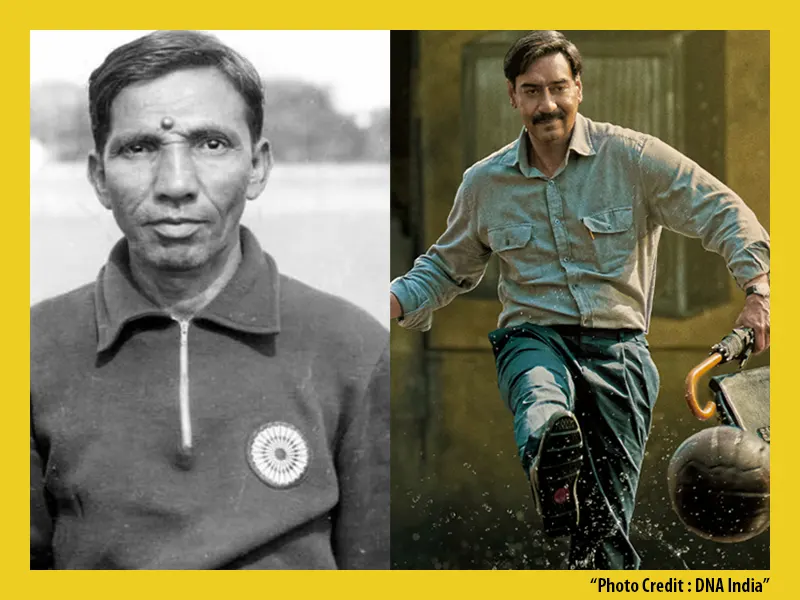
S.A. Qureshi was struggling to stand on his feet during the final football match between India and Korea. It wasn’t just a game for him—it was the culmination of a lifetime of sacrifice, vision, and resilience. As I sat on the couch watching the climax of Maidaan, my eyes welled up. The emotion in the scene, the intensity, and the raw determination portrayed on screen had broken my stoic shell. Tears trickled down my cheeks, unnoticed—until my wife entered the room.
She paused, looking at me and then at the television. “You never shed a tear while I was ill and suffering,” she said softly.
I was speechless. Her words echoed in the room, cutting deeper than I expected. All I could do was wipe the tears from my cheeks and glance back at the screen.
I was watching Maidaan—a film that goes beyond being inspirational. It’s a journey that touches the very soul of anyone who has ever dared to dream, especially in the face of opposition. For a hypersensitive person like me, watching it alone magnified every emotion tenfold.
The story unfolds around Syed Abdul Rahim, the architect of modern Indian football, who defied every odd in post-independence India. With limited resources, bureaucratic hurdles, and societal neglect of football, Rahim emerged as a lone warrior. He wasn’t just coaching a team—he was sculpting a national identity, trying to bring glory to a forgotten sport. Watching him fight the system, believe in his boys, and hold the nation’s flag high was deeply moving. His personal battles—be it health, politics, or professional betrayal—did not deter him. They made him stronger.
And then there was Ajay Devgn.
Having grown up admiring him, I was stunned by the depth and dignity he brought to the role. Ajay Devgn has been a part of my cinematic journey since childhood. In my teenage years, it was his action-packed avatar that drew me to him. Movies like Phool Aur Kaante, Jigar, Platform, and Sangram made him my screen hero. His dual-bike split entry in Phool Aur Kaante is etched in every 90s kid’s memory. Those films shaped our perception of raw masculinity—stoic, rugged, and unyielding.
Back then, we didn’t have the liberty to watch every film in theatres. But once I completed my twelfth, that changed. I vividly remember watching Zakhm in a cinema hall—my first Ajay Devgn film on the big screen. Expecting yet another action saga, I was instead swept into a world of emotional depth and political poignancy. Zakhm was a drama, but it was impactful. I was impressed by his layered performance. It was perhaps the first time I realized that Ajay was more than an action hero—he was a powerhouse of emotion.
Over the years, I followed his filmography—sometimes sporadically, sometimes obsessively. From The Legend of Bhagat Singh to Drishyam, and now Maidaan, his transformation as an actor has been profound. With Maidaan, he doesn’t just act—he becomes Rahim Saab. His restrained delivery, his piercing silences, and his ability to command without dramatics are testimony to how far he’s come. He doesn’t need elaborate dialogues to move you. His presence does that.
What Maidaan does beautifully is celebrate unsung heroes. In a cricket-obsessed country, football has often been relegated to the sidelines. The film reclaims that space. It shows how sports, when approached with vision and honesty, can unite a fractured society. The Indo-Korean match wasn’t just about winning—it was about proving that India, too, could dream big on the global stage.
The movie also subtly critiques the system. The bureaucracy, the politics, the apathy—it’s all there. But instead of being preachy, the film lets the struggle speak through Rahim’s persistence. It’s a tribute to leadership that doesn’t shout but whispers through actions.
As the credits rolled, I sat there—still absorbing, still feeling.
The silence in the room wasn’t empty. It was full—of admiration, of introspection, of unresolved thoughts. My wife sat beside me now, no longer questioning my tears. Perhaps she understood—these weren’t just about football or films. They were about belief, about legacy, and about the rare individuals who carve paths when none exist.
Maidaan isn’t just a movie. It’s a reminder—that dreams need defenders, and fields need dreamers.
In a world full of noise, it’s the silent revolutionaries like Rahim Saab—and the storytellers like Ajay Devgn—who leave the loudest echoes.
And as I turned off the TV, I realized something else.
Sometimes, we cry not because we’re weak, but because we’ve finally seen someone fight the battle we’re too afraid to start.
And in those tears, there is healing.
There is inspiration.
There is hope.