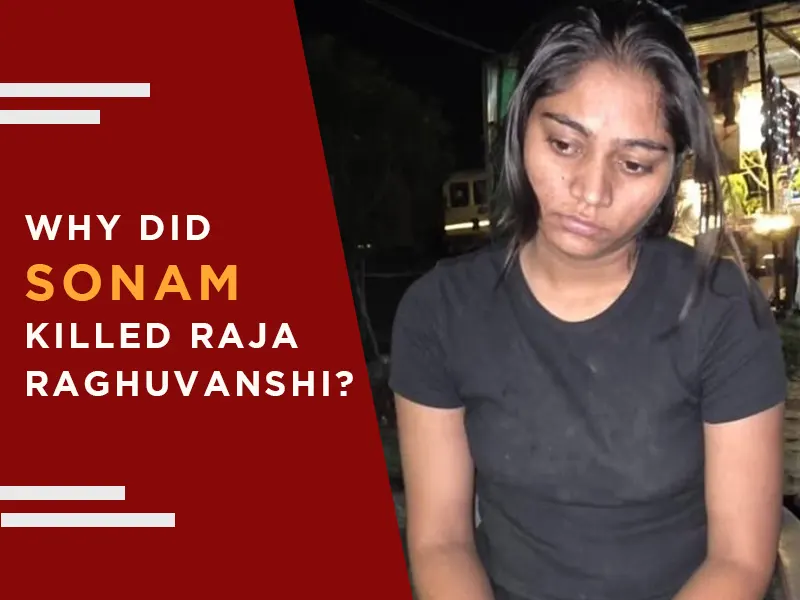
Now, Sonam is behind bars. The law has taken its course, and the police claim to have gathered ample evidence against her—enough to prosecute her for her actions. The media is abuzz with the news, social media platforms are flooded with posts cursing her, and people across society are quick to label her as a murderer. The crime she is accused of—taking the life of an innocent man named Raja—has shocked and angered the public. The trolling, the outrage, and the condemnation seem to have no end. But amidst all this noise, I find myself grappling with a different set of questions.
Why did this happen? What drove Sonam to take such an extreme and irreversible step? Could it have been avoided? Was there any way in which she could have achieved what she truly wanted without such tragic consequences? And, most importantly, what can we as a society learn from this so that something like this does not happen again?
When we seek to truly understand or diagnose a problem, it is not enough to look at it from just one angle or to focus solely on the obvious facts. Sometimes, we need to go deeper, to try and see the situation through the eyes of everyone involved. In this case, perhaps we need to consider Sonam’s perspective as well. Let me make it clear: I am not here to defend Sonam’s actions. I am not trying to justify a crime or create any kind of propaganda. My aim is simply to understand the root causes of this tragedy. If we can identify those causes, perhaps we can work towards building a society where such heart-breaking incidents are less likely to occur. My only agenda is to reflect on how we can make our world a better, kinder, and more just place for everyone.
From what we know, Sonam was in love with a man named Raj Kushwaha. Raj belonged to a caste considered lower than hers by the societal standards of their community. Adding to that, his position as an accountant in their family business placed him at a lower rung financially and socially, at least in the eyes of Sonam’s family. Sonam’s desire was simple, and one that many people share—she wanted to marry the person she loved. But in a society deeply entrenched in rigid notions of caste, status, and honor, what should have been a straightforward wish became an insurmountable challenge.
I do not claim to know exactly what went on in Sonam’s mind. No one can truly know that except for Sonam herself. But I can make some reasoned guesses, because I too live in the same kind of society. I too have seen how social pressures, family expectations, and community judgments can weigh heavily on individuals, especially women. In Sonam’s position, it must have been incredibly difficult—perhaps even impossible—for her to express her wish to marry Raj openly. To do so would have meant facing the wrath of her father, her brother, and perhaps the entire extended family.
Her mother might have had an inkling of her feelings for Raj. But either she lacked the power to support her daughter, or she did not believe that Sonam’s relationship with Raj was right or practical. We know how, in many traditional families, even mothers who deeply love their children sometimes cannot protect them from the crushing weight of societal expectations.
Sonam probably feared that if she expressed her wish to marry Raj, not only would her own life become a living hell, but Raj’s life would be at risk too. He might have been harassed, humiliated, or worse. We have seen far too many cases where men from so-called lower castes face violence, threats, and endless trouble for daring to fall in love with someone from a higher caste. Perhaps Sonam, seeing no other way out, decided that marrying the man chosen by her family—Raja—would be the safest way forward. But once married, she may have felt trapped.
The dream of a life with Raj must have seemed more distant than ever, and the reality of her marriage perhaps felt unbearable.
What led her to take the drastic and tragic decision to kill Raja rather than revolt openly against her family’s wishes? That question haunts me. Could it be that she felt utterly powerless? That she saw no other way to reclaim her agency, her right to choose, her freedom? Did she believe that by removing Raja from the picture, she could somehow clear the path to be with Raj? These are troubling thoughts, but perhaps they offer a glimpse into the desperation she might have felt.
Of course, nothing can justify the taking of an innocent life. Raja was not to blame for any of this. He was a victim of circumstances, just as much as Sonam was. He, too, was caught in the web of societal expectations, family pressures, and the rigid structures that dictate who we can love, who we can marry, and how we should live.
But if we stop at merely blaming Sonam, we miss the bigger picture. This tragedy is not just about one woman making a terrible choice. It is about a society that makes it so difficult for people, especially women, to follow their hearts. It is about a culture that values caste, status, and honor over individual happiness and freedom. It is about families that force their children into marriages without truly caring about their wishes, their dreams, or their consent.
If we really want to prevent such tragedies from happening again, we need to ask ourselves some hard questions. Why do we still allow caste to dictate our choices in the 21st century? Why do we continue to see love between people of different backgrounds as a threat rather than a beautiful possibility? Why do families see their honor tied up in controlling their children’s lives? And why is it so hard for young women like Sonam to find safe spaces where they can voice their desires without fear of punishment or shame?
We need to create a society where conversations about love, marriage, and personal choice can happen openly and respectfully within families. We need to teach our children, from a young age, that their worth is not tied to their caste, their bank balance, or what society thinks of them. We need to ensure that mothers, fathers, brothers, and sisters become allies in their children’s pursuit of happiness, not obstacles. And we must strengthen our legal and social systems so that those who face threats for choosing love across caste lines can find protection and support.
Let us not forget that Sonam’s story is not unique. There are countless Sonams and Rajs in our country and beyond, who suffer in silence, who are forced to give up on love, or who face violence and hatred for following their hearts. Every time we read about such cases, we need to remind ourselves that change begins with us—with how we think, how we speak, and how we act.
If we want to build a better society, we must challenge the outdated beliefs and practices that continue to cause so much harm. We must create environments where love is celebrated, where individual choices are respected, and where no one feels so trapped that they see no way out other than tragedy.
Sonam’s story is a wake-up call. Let us not waste it by stopping at outrage or blame. Let us use it as an opportunity to reflect, to learn, and to work towards a society where such stories become a thing of the past.