Here’s an argument I came across recently that’s been sitting with me: social media platforms like Facebook weren’t built for a place like India. They were built for America.
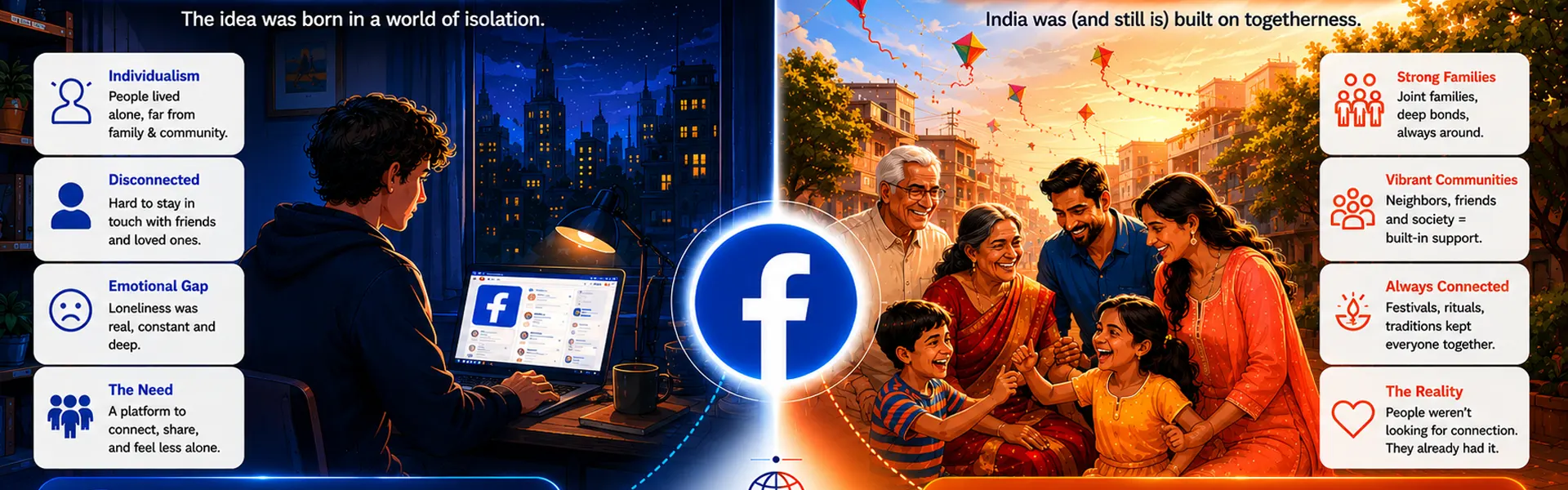
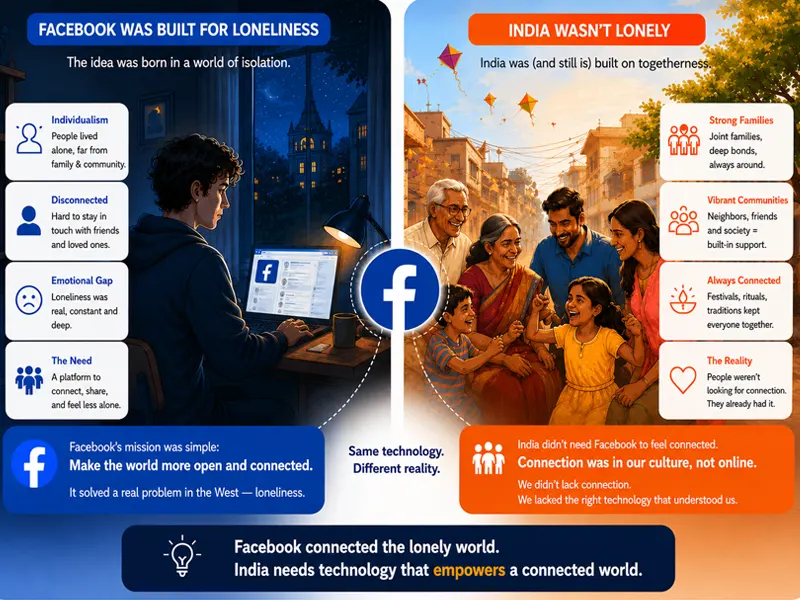
Think about the conditions that produced Facebook. A society where neighbors don’t know each other’s names. Where extended family is a phone call on holidays, not a presence in the next room. Where suburban design — wide roads, no sidewalks, no third places — actively engineers people into isolation. Where individualism isn’t just a value, it’s an architecture: you build your own life, your own identity, your own social circle from scratch, often far from where you grew up.
In that context, a platform that lets you broadcast your life and harvest small hits of connection from scattered acquaintances isn’t filling a luxury — it’s filling a void. Facebook’s early pitch basically was: we’ll give you back a village, except digital. For a culture starved of casual, ambient social contact, that’s a genuinely useful product.
Now look at India. Joint families under one roof. Neighbors who walk into your house without knocking. Weddings with 500 guests who all actually know you. A culture where being alone is often treated as something slightly wrong with you, not an achievement. Social life in India wasn’t scarce — if anything, the complaint has historically run the other way: too little privacy, too little space to be alone.
So why did a product engineered to cure American loneliness become a runaway hit in a country that didn’t have that problem? And not just a hit — India is now Facebook and WhatsApp’s largest market in the world by user count.
The honest answer is that the platforms didn’t sell us connection. They sold us something else entirely, and we didn’t notice the swap.
What got exported wasn’t a solution to isolation. It was a behavior pattern — compulsive checking, comparison, performance — that happened to be calibrated for a lonely person trying to fill a gap. Transplant that pattern onto a person who already has a full, dense, demanding social life, and you don’t get fulfillment. You get addition — one more layer of obligation and comparison stacked on top of a social life that was already plenty full. Indian social media use often isn’t replacing absent community; it’s running parallel to an already-saturated social calendar, which may be why it manifests less as “finally, connection” and more as anxiety, comparison, and the particular exhaustion of performing two social lives at once — the real one and the online one.
There’s a counterargument worth taking seriously here, though: India isn’t one undifferentiated mass of joint-family warmth. Migration to cities, the breakdown of traditional support structures in urban India, nuclear families replacing joint ones, the isolation of the elderly left behind in villages — these are real and growing. For a 23-year-old who’s moved to Bangalore for work and knows nobody, Instagram might function exactly as it was designed to. The “India wasn’t lonely” argument can flatten a country of 1.4 billion people into a single social condition that doesn’t actually hold everywhere.
It’s also worth asking what these platforms are actually optimized for, regardless of geography. Facebook and Instagram weren’t really built to solve loneliness as a humanitarian project — they were built to maximize engagement and ad revenue, and “solving loneliness” was simply the most effective hook for the American market they launched in first. That the product worked differently when it landed somewhere with different social conditions doesn’t mean it was redesigned for India — it means the same engagement-maximizing machinery got pointed at a population with a different starting point, and the side effects look different as a result.
That distinction matters. It reframes the question from “was this built for us?” to “what happens when a tool built for one psychological condition gets used at scale by people in a completely different one?” And that’s arguably the more useful question for understanding why Indian social media use feels the way it does — less like relief, more like static.