School pe bike laate hain, police kahan hai?
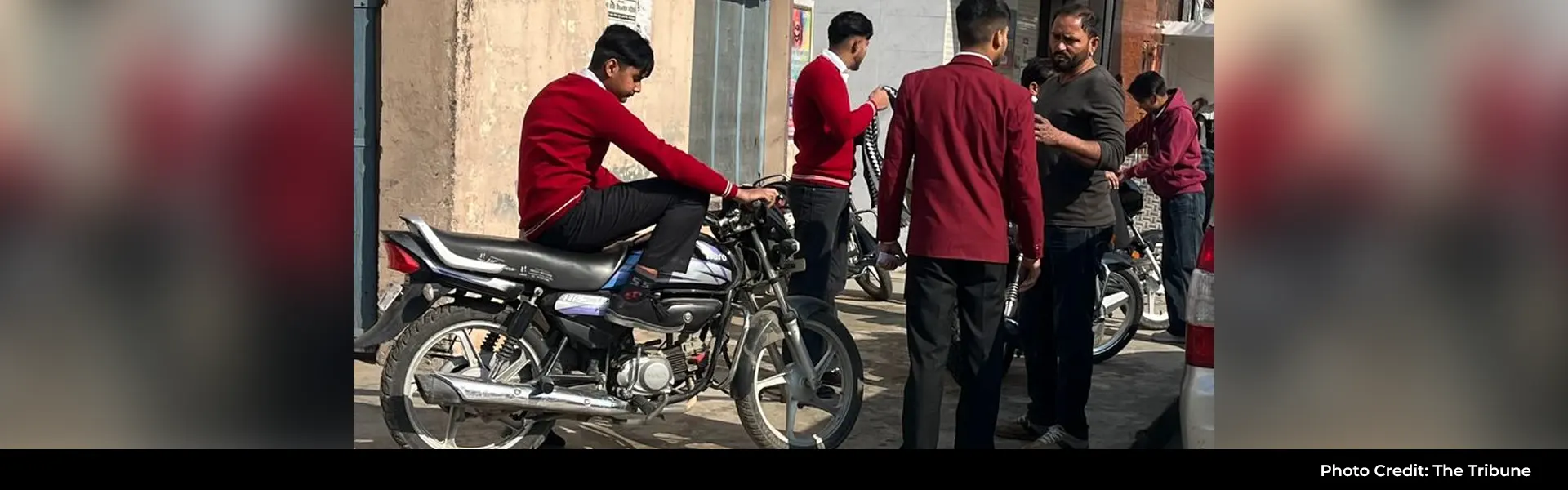
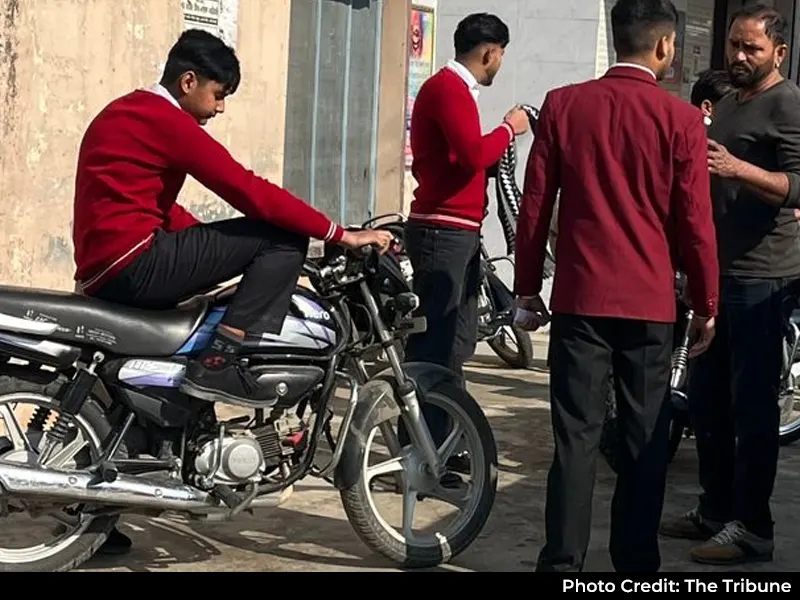
Students under 18 are riding to school on two-wheelers daily. The school lets them park. The traffic police look the other way. And we call this normal.
Stand outside any school gate in Faridabad — or any city in India — between 7:30 and 8:30 in the morning. Watch what rolls in. You’ll see 15-year-olds on 110cc bikes, 16-year-olds on scooters, no helmets, weaving through morning traffic, parking confidently inside school premises. And then watch what doesn’t happen: absolutely nothing. No cop. No challan. No consequence.
This happens every single day. It’s not a secret. The school knows. The police know. Parents know — many of them handed over the keys themselves. And somehow, collectively, everyone has decided this is fine.
“The law is not ambiguous. Riding a two-wheeler under 18 without a license is illegal. What’s ambiguous is why no one enforces it.”
What the law actually says
This isn’t a gray area. The Motor Vehicles Act is clear. Yet three separate parties fail at their responsibilities every morning.
Minimum age for a license
18 years for any motorized vehicle. A learner’s license is available from 16, but only for gearless vehicles under 50cc — not a 110cc bike.
Helmet mandate
Mandatory for both rider and pillion under the MV Act. Violation is a challan-able offense — but rarely enforced near school zones.
Parental liability
Under MV Act Section 180, parents or guardians who allow minors to drive face a fine of ₹25,000 and up to 3 years imprisonment.
School’s duty of care
Schools are legally obligated to maintain safe environments. Knowingly permitting illegal vehicles on premises is a failure of that duty.
Who is failing — and how
Traffic police
Positioned on major roads, largely absent from school-zone side streets during peak hours. No dedicated deployment, no challan drives near school gates.
Primary enforcement body. Primary failure.
The school
No policy against student two-wheelers. No verification at the gate. Parking space is available and used freely by unlicensed riders.
Could ban student two-wheelers tomorrow. Hasn’t.
Parents
Hand over keys to avoid the hassle of dropping kids. Believe their child is “careful.” Are legally liable under the MV Act.
Convenience over compliance — and over their child’s safety.
Municipal authority
No mandatory school-zone traffic safety guidelines. No periodic audits of vehicular access to school premises.
Systemic gap. Regulatory silence.
The accident is not a matter of “if”
An unlicensed 15-year-old has had, at best, a few months of watching someone else ride. No formal training. No hazard perception skills. No understanding of road rules beyond “gas goes forward, brake goes stop.” Put them in morning school-zone traffic — buses, autos, pedestrians, cyclists all competing for space — and you’re not creating a commute. You’re creating a countdown.
When the accident happens — and statistically it will — everyone will call it tragic. Nobody will call it preventable. But it is. It is entirely, obviously preventable. The law exists. The mechanism to enforce it exists. The will does not.
“We build speed bumps outside schools. We paint zebra crossings. And then we let unlicensed teenagers ride in on bikes every morning. The irony is not subtle.”
What needs to happen — and it’s not complicated
No new law is needed. No new committee. No lengthy policy review. Three things, starting Monday:
One — traffic police deploy one constable per school gate during the 30 minutes before school starts. Not a whole team. One person. Visible. Present.
Two — schools issue a circular: student two-wheelers will not be permitted inside school premises without a valid license on record. The security guard at the gate enforces it.
Three — parents receive a written reminder that handing keys to a minor is a criminal offense under Indian law, not a parenting choice.
None of this requires a budget. None of it requires a new department. It requires someone to decide that the lives of 15-year-olds are worth thirty minutes of attention at the school gate.
The plain truth
Every morning that a minor rides a bike to school unchallenged, it isn’t just a traffic violation going unpunished. It’s a message being sent — that rules are decorative, that enforcement is optional, and that convenience beats accountability. The school gate is where that message gets written. It’s also where it can be erased.